Showing posts with label post-conflict reconstruction. Show all posts

Monday, February 9, 2009

How UNDP Helped the Republic of Georgia After Conflict


In August 2008 there was a conflict between Russia and Georgia. The conflict destroyed livelihoods of many. To help restore normalcy to Georgia, the United Nations Development Program worked closely with the Georgian Government.

We could write more about it, but instead we thought you might like to listen:

Check out this video blog by UNDP staff member Louisa Vinton to learn about UNDP's efforts.

Friday, October 3, 2008

UN Common Humanitarian Fund to Benefit One Million in Central African Republic


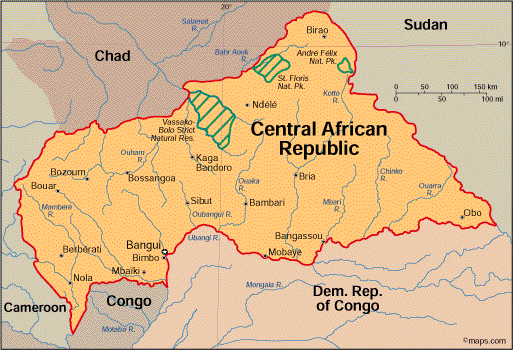
The Central African Republic (CAR), having been subjected to violence as a result of spill-over from Darfur, will receive money from the new United Nations Common Humanitarian Fund. The increasing instability in CAR, a result of the escalating violence neighboring Chad and Sudan’s Darfur region, has affected more than one million people in the country. 2.5 million dollars has been pledged by the United States, directing the funds to be focused on health care, access to water, survival of infants and young people, and aid to help those who have been displaced. The new funding will allow humanitarian action to be more efficient; it will be directed to the 110,000 displaced people and the one million others affected by the conflict. The influx of funds will allow those on the ground to respond to emergencies faster and more efficiently.

Wednesday, September 24, 2008

UN Helps Settle over 5,000 Refugees from Bhutan

The Office of the United Nations High Commissioner for Refugees [UNHCR] helped more than 5,000 refugees from Bhutan leave their camps in Nepal for resettlement in other countries. The United States accepted the largest number of refugees with 4,833, followed by 131 refugees in Australia and 129 in New Zealand. The program hopes to resettle another 2,000 to 3,000 before the end of the year. There are currently 107,000 refugees originating from Bhutan living in seven camps in eastern Nepal. Nearly half of them have expressed an interest in resettlement. Some of the refugees have been in exile for as long as 17 years. The resettlement process has run smoothly due to the collaborative efforts of UNHCR, the International Organization for Migration [IOM], the Nepalese government and the resettlement countries. The program has created opportunities for success for the refugees by holding English classes and skill-training at the camps. "Although starting over is not easy, there is a program for everyone with the resettling agencies, no matter what age, qualification or gender. We have seen other former refugees doing well, so we can do it as well," says one refugee who recently arrived in the U.S.

Tuesday, September 23, 2008

New Hope in Somali Conflict

The United Nations Political Office for Somalia reached a new level of peace in Somalia through its inter-party, international dialogues. According to a communication document released on Sunday September 21st, two parties The Transitional Federal Government (TFG) and the Alliance for the Re-liberation of Somalia (ARS) held a second round of High Level Committee and Joint Security Committee (Djibouti) meetings from the 17th through the 21st. Also present were the United Nations, African Union, European Union, League of Arab States, the Organization of Islamic Conference, representatives from other countries, and Somali civilians. During the meeting, both parties solidified their efforts to continue peace talks, and set up sub-committees in order to implement the outlines already established by the Djibouti agreement. In addition, both parties agreed to conduct field assessments, and form a Board that would coordinate with the humanitarian efforts in the region.
The meeting proved to be another step in what the international community hopes, is a successful solution to the current humanitarian crisis in Somalia.

Tuesday, August 19, 2008

Remembering and Embodying UN legend Sergio Vieira de Mello


When a truck laden with explosives crashed into Baghdad's Canal Hotel August 19, 2003, 22 dedicated public servants perished. On the anniversary of this attack, it is important not only to remember those whose lives were tragically and unjustly cut short, but their principles. In today’s world where foreign policy is shaped by hard power and military might, it is essential to stick to Sergio Vieira de Mello’s belief in the power of conversation and peaceful negotiation.

Sergio, the mission’s head, is regarded as a legend within UN and foreign policy circles. The efforts of the talented peacemaker and diplomat have resulted in the repatriation on countless Cambodian refugees, and Sergio led the building of the world’s newest nation, East Timor. His remarkable abilities as a negotiator and his unwavering dedication to fostering peace was recognized by Secretary General Kofi Annan, who appointed Sergio to lead the mission head in Iraq. He had little time to fulfill his humanitarian and diplomatic duties, as the terrorist’s bomb claimed his life only months into his mission.

Sergio’s legacy continues: he is the subject of Chasing the Flame, a newly released book by Pulitzer Prize Winner Samantha Power. Both an HBO documentary and feature film based on his extraordinary life are in the works. Also be sure to check out the new blog, also titled Chasing the Flame. It is dedicated to keeping Sergio’s peacemaking vision alive. His devotion to fostering constructive and open dialogue is as relevant and important as ever to shaping American foreign policy.

Reminiscing on Sergio’s memorable role in crafting a more peaceful form of diplomacy, Annick Stevenson opens the Chasing the Flame blog:

Imagine a world in which everybody would speak to his/her neighbor, would listen to his/her views and would try to understand them, would, more generally, always wish to know the will of others before deciding, would negotiate before envisaging any military reaction, would never ever view war as the solution to any conflict whatever the reasons may be...A world in which war would become impossible because it would too difficult to think of killing someone you share so much with. This world existed. It was in the mind of Sergio Vieira de Mello. This is how he conceived it and lived it, as much as he could, or at least as a matter of principle.

Five years later, let us not only honor his memory, but follow his example.

Visit the Sergio Vieira de Mello Foundation

Image Credit: the Sergio Vieira de Mello Foundation

Friday, December 28, 2007

Liberia needs police, women step up to the plate (with the UN's help)


This week over 100 Liberian women completed basic training for the Liberian National Police (LNP). The women participated in a program sponsored by the UN, the Liberian Government, and the LNP. The program was designed to help Liberian women conquer some of the challenges they face. The goals of the program are to increase the number of women on the police force to 20% of the total force, as well as help raise women's educational level to high school graduate, which is needed to qualify for the force. Today about 10% of LNP officers are women.

The UN and the Liberian government hope that more women in the police force will be allow the LNP to be more effective in handling sexual and gender violence against women and children. The President of Liberia, Ellen Johnson Sirleaf, commended the women for their role in nation building and along with the UN sees women's empowerment as an important step towards good governance.

For more information about this program and others: click here

Friday, December 14, 2007

Helping the People of Iraq

Some good news from the Iraq operations of the UN Refugee Agency, UNHCR this week:

  • Earlier this week they announced that over 20,000 Iraqi Refugees have been resettled this year. While it is horrible that these individuals have suffered trauma and have had to leave their homes, UNHCR is working hard to make sure that these people have the chance at a normal life in their new nations. For a sense of what this entails, check out this story on UNHCR's website.
  • For the most desperate of the 2.2 million Iraqi refugees that are still in refugee camps on in Syria and Jordan, on Sunday UNHCR will begin providing finanical assistance via ATM cards with $100-200/month. Cash assistance helps families to purchase necessities when they need them. It is expected that 7,000 families will initially benefit from this emergency relief.
  • To top it off, UNHCR is helping the Iraqi Government to help 5,000 families (about 30,000 individuals) who wish to return to their homes by providing them support packages and repair kits.